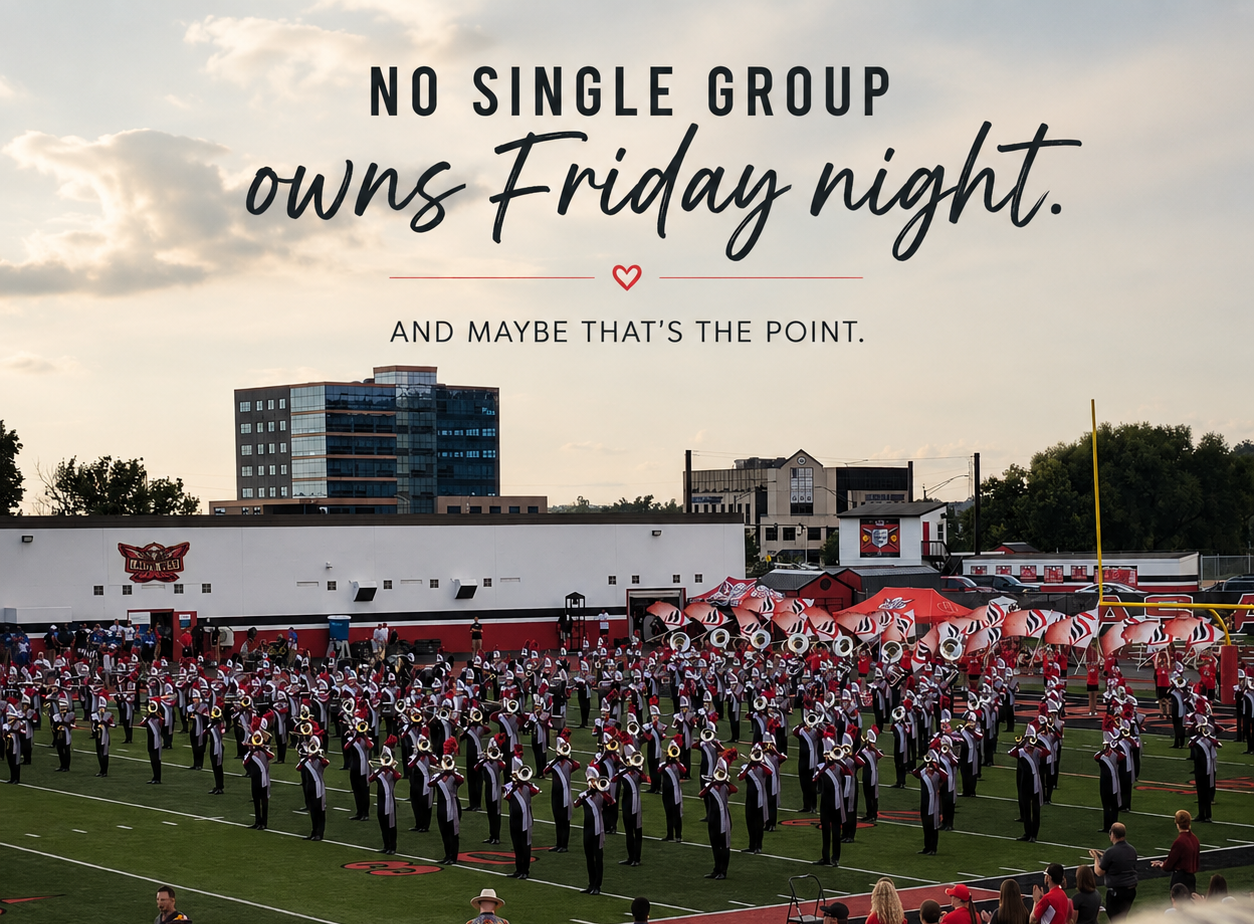
High school football games might be one of my favorite things in the world.
And honestly, the football is only part of it.
There’s something wonderfully simple about a Friday night under the lights. The players are playing. The cheerleaders are cheering. The band is playing entirely too loudly. The student section is doing whatever the student section does. Parents are embarrassing their children from the stands.
For a few hours, hundreds of kids get to be completely invested in something they love.
I love that.
Maybe because I spend so much of my professional life wondering how we help children find the thing that makes them want to get up at three o’clock on a Saturday morning just so they can get back to doing it.
At a Friday night football game, I get to watch hundreds of them finding it.
Last night, though, I noticed something.
We were sitting behind the family of one of the football players. They were excited. Really excited. They stood and cheered for their child, and I genuinely loved watching that.
At one point, an older fan asked if they would sit so the people behind them could see the game.
They made it pretty clear that wasn’t happening.
They were there to watch their kid.
Fair enough.
But it made me start looking around the stadium.
There were hundreds of people in those stands. A huge portion of them were families of band members.
And they were cheering too.
When the football team made a great play, they cheered. When someone scored, they cheered. When the cheerleaders got the crowd going, they joined in.
They had come because their children were in the band, but for most of the game, they were cheering for someone else’s kids.
Then halftime came.
The band took the field.
And people started leaving.
Concessions. Bathroom. Time to find someone sitting in another section. Time to talk.
And I found myself watching people stream out of the stands while a group of KIDS walked onto the field to do the thing they had spent countless hours preparing to do.
It made me a little sad.
Because I don’t think most people mean anything by it.
We’re simply paying attention to the thing we came to see.
But I found myself wondering:
Do we realize those are someone’s children too?
My son is one of those kids.
So I know what happens long before the band ever takes the field on Friday night.
These kids practice every day, often for three, four, or five hours. They learn music. They memorize movement. They learn to play while moving, watch one another, listen to one another, respond to cues, and somehow move as one enormous organism while carrying instruments that were definitely not designed with marching in mind.
Many of them play multiple instruments.
They spend Friday night in the stands supporting the football team, perform their own show, finish the game, go home, and many times wake up early Saturday morning to travel (sometimes two or three hours) to a marching band competition.
Then they do it again.
And again.
And again.
I don’t say that because I think band kids work harder than football players.
This isn’t a competition over whose passion is most deserving of our respect.
I say it because from the stands, it’s easy to see only the performance and miss all the becoming that happened before it.
And while we’re at it, can we talk about the cheerleaders for a minute?
I was one once, so maybe I’m a little biased.
Those kids may look small.
But they are mighty!
They spend hours in the gym learning to tumble. They strength train so they can lift another human being over their heads. They learn timing, balance, coordination, trust, endurance, and the ability to remain remarkably calm while someone is flying through the air above them, or trusting they will be caught.
They are athletes.
Full stop.
And they don’t always get the respect they deserve either.
Which is when I realized that maybe what I love so much about Friday night isn’t any one of these things.
It’s all of them.
No single group owns Friday night.
The football players provide the game.
The cheerleaders give us energy.
The band gives it a soundtrack.
The students give it personality.
The families fill the stands.
Together, they create something none of them could create alone.
That’s the magic.
Take away the band, and Friday night feels different.
Take away the cheerleaders, and it feels different.
Take away the student section, the families, the coaches, the volunteers, the little kids running around in school colors imagining the day they’ll be out there too…
It all matters.
Because community isn’t created by everyone making the same contribution.
It’s created when people bring different contributions and somehow build something bigger together.
Maybe that’s why last night stayed with me.
I spend so much time thinking about how we help children discover what they love.
We tell them to find their passion. Find their strengths. Work hard. Join something. Contribute. Find their people. Discover the thing that lights them up.
And then there I was, sitting in a stadium filled with children who were doing exactly that.
Some had found football.
Some had found music.
Some had found cheer.
Some had found the glorious chaos of the student section.
Their thing didn’t have to be the same thing.
That’s the point.
We don’t need every child to become passionate about the same things.
We need them to discover that there is something worth becoming passionate about.
And when they do, maybe one of the simplest things the rest of us can do is notice.
We see children performing. We don’t always see children becoming.
We don’t see the thousands of repetitions before the touchdown.
We don’t see the hours in the gym before the cheerleader flies into the air.
We don’t see the rehearsals before the first note.
We see the moment.
But behind that moment is a young person becoming an athlete, a musician, a performer, a teammate, a leader.
They’re finding out what they’re capable of.
They’re learning what it means to commit to something.
They’re discovering what it feels like to contribute something that matters to other people.
Maybe one of the ways we teach children that their contribution matters is remarkably simple.
We notice it.
One of my colleagues, a guidance counselor, used to have a sticker on her water bottle that said:
I cheer for both teams.
It was the perfect sticker for her.
I always liked it, but sitting in those stands Friday night, I started thinking about it differently.
Maybe cheering for someone else doesn’t take anything away from the person we came to support.
I can cheer wildly for my own child and still clap for yours.
I can want our football team to win and still recognize the work happening on the other sideline.
I can be there for the band and cheer when the cheerleaders nail a stunt.
There is enough pride to go around.
Maybe that’s part of what community asks of us.
Not to care less about our own people.
To make our circle of people worth cheering for a little bigger.
Love your kid ridiculously.
Cheer for them obnoxiously.
Be incredibly proud of their thing.
And then save a little applause for someone else’s kid too.
I’ll keep cheering when the football team scores.
I’ll cheer when the cheerleaders take to the sidelines.
I’ll probably cheer embarrassingly loudly when the band marches out, because my kid is one of them and that’s a parent’s prerogative.
But I hope I never become so focused on watching my own child shine that I forget to notice someone else’s.
Because everywhere I looked Friday night, kids were doing exactly what we spend so much of their childhood hoping they’ll eventually do.
They had found something they loved.
They were working incredibly hard at it.
They belonged to something bigger than themselves.
And they were contributing something that only they could contribute.
What they do matters.
Not just to their parents.
Not just when they’re the reason we came.
It matters because they matter.
So when someone else’s child takes the field, maybe we stay in our seats for a few more minutes.
We watch.
We clap.
We let them know we see them.
Cheer for ALL of them.
 Meraki Minds
Leave a comment