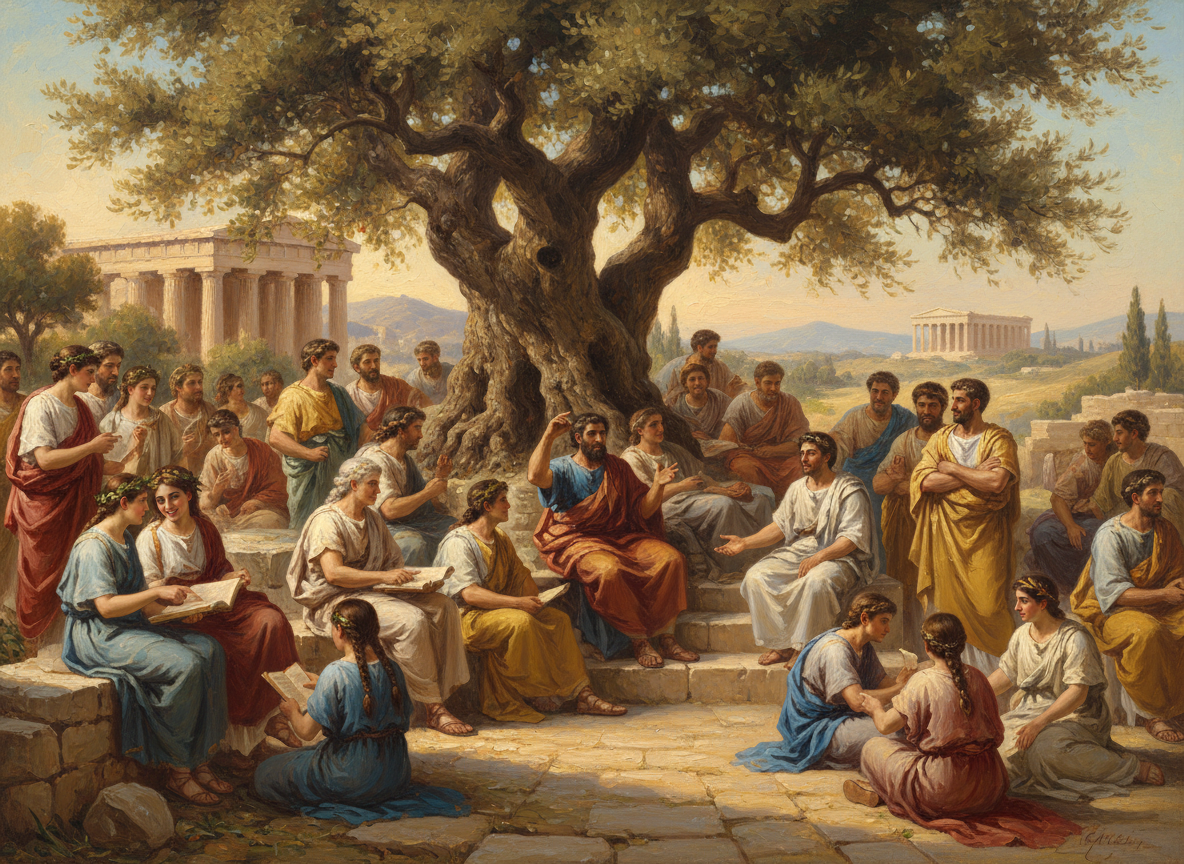
Sometimes I look around my classroom and imagine what it must have felt like to sit beneath the trees of ancient Greece, surrounded by people wrestling with questions no one had answered before.
If I had lived in ancient Greece, I like to imagine I would have been sitting among them, asking questions, listening carefully, building on someone else’s ideas, and changing my mind when a better argument emerged.
They weren’t completing assignments.
They weren’t trying to earn points.
They were observing, questioning, debating, and constructing knowledge together.
Every time I gather with my students around a table, listening as they wonder aloud, challenge one another’s thinking, defend an idea with evidence, or discover a connection none of us had noticed before, I catch a glimpse of that same spirit.
That is the classroom I’ve spent my career trying to build.
Welcome to Meraki Minds!
If you’re here expecting a journal filled with classroom tips, printable resources, and teaching strategies, you’ll certainly find those along the way. But I hope you’ll also discover something deeper.
Because I don’t believe the most important work we do as educators is simply helping students learn more.
I believe it’s helping them become more.
My journey began in a middle school mathematics classroom, where I spent nearly two decades teaching students far more than equations and procedures. From the very beginning, I believed students deserved ownership of their learning. Long before student agency became a familiar phrase in education, I was creating a classroom where students made decisions, assessed their own readiness, collaborated with one another, sought feedback, and challenged themselves to go further.
My classroom revolved around a simple four quadrant system. Students learned new concepts together, practiced until they felt confident, demonstrated their understanding through meaningful performance tasks, and explored extensions whenever they were ready to think more deeply.
The system wasn’t really about organization.
It wasn’t about classroom management.
It wasn’t even about mathematics.
It was about trust.
Trusting students to know when they needed more practice.
Trusting them to ask for help.
Trusting them to challenge themselves.
Trusting them to learn from mistakes.
Most importantly, trusting them to take ownership of becoming mathematicians instead of simply completing math assignments.
Looking back, I realize I wasn’t just teaching mathematics. I was helping students develop an identity.
When I became a full-time Gifted Intervention Specialist, people often assumed I had entered an entirely new chapter of my career.
In reality, my philosophy hadn’t changed.
It had simply grown.
Instead of asking, How do I help students become mathematicians? I found myself asking bigger questions.
How do students begin thinking like scientists?
How do they learn to see the world through the eyes of an artist?
What does it mean to reason like a historian, design like an engineer, or wonder like a philosopher?
Eventually, all of those questions gave way to one that has become the foundation of everything I create.
Who will students become because of this experience?
That question now guides every lesson, every project, every classroom conversation, and every resource I design.
You’ll notice that many of the ideas shared here return to the same themes:
Curiosity. Wonder. Meaningful work. Visible thinking. Creative risk taking. Reflection.
Not because they’re educational buzzwords, but because I believe these are the habits that shape people long after they’ve forgotten the details of a lesson.
Students may not remember every book they read or every activity they completed.
But they often remember how learning made them feel.
How it challenged them.
How it invited them to think.
How it helped them discover something about themselves.
That is the kind of learning that stays with us.
Eventually, I discovered the Greek word meraki. It describes doing something with soul, creativity, and a little piece of yourself. The moment I encountered that word, it felt as though someone had given a name to what I’d been trying to cultivate all along.
Not perfect work.
Meaningful work.
Work that carries a little of who we are.
That’s what I hope for my students.
And it’s what I hope Meraki Minds will encourage in classrooms everywhere.
Perhaps that’s why I don’t think this journal is really about education.
I think it’s about the life of the mind.
Education simply happens to be the place where I have the privilege of inviting children, and the educators who guide them, to experience it.
If you choose to follow along, you’ll find practical ideas, classroom resources, stories from my own teaching, and reflections on curiosity, creativity, and inquiry.
But more than anything, I hope you’ll find a community of educators who believe that learning is something we build together.
I don’t believe classrooms should be places where knowledge is delivered.
I believe they should be places where ideas are explored together.
Where teachers remain curious.
Where students learn to question.
Where every person in the room leaves knowing a little more than they did when they walked in.
If I could choose any place in history to sit and learn, it might just be beneath those trees.
Since I can’t, I’ve spent my career trying to build the next best thing.
Welcome to the conversation.
I’m so glad you’re here.
 Meraki Minds
Leave a comment