I am very good at helping.
I’m a teacher.
It’s practically an occupational hazard.
I can spot a problem from across a classroom and immediately start generating solutions.
Maybe point something out.
Offer a tool.
Give them a piece of information they’re missing.
Surely I can make this easier.
Right?
Then my daughter joined Destination Imagination.
I had no idea what I was getting myself into.
She started DI in fourth grade. When I signed her up, there was a little box asking whether I would be willing to help.
Of course I checked it.
I am a helpful person.
A few weeks later, I received an email that essentially said:
“Hi, Team Managers! Here’s your team!”
Oof.
Apparently I had volunteered to be in charge.
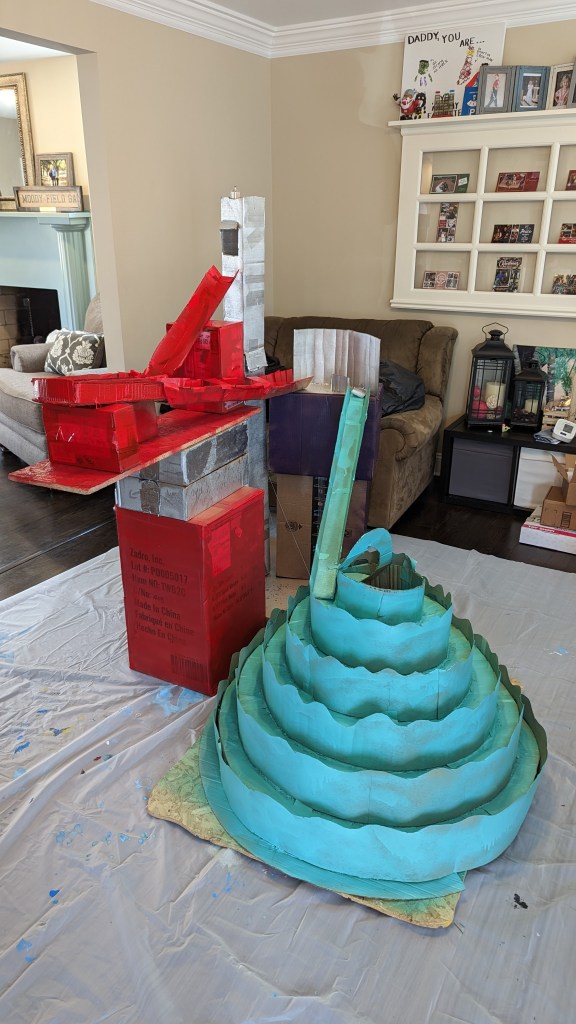
And that’s how my co-manager and I, neither of whom had ever done Destination Imagination, ended up with six third, fourth, and fifth graders in my house every week for two hours attempting to build a working roller coaster inside a six-foot-by-six-foot space.
No one knew what they were doing.
The children didn’t.
We didn’t.
It was perfect.
If you’ve never experienced Destination Imagination, there’s one rule you need to understand.
Adults cannot contribute to the team’s solution.
Not a little.
Not a suggestion.
Not a “You know what I would do?”
Not a strategically raised eyebrow while staring directly at the obviously questionable part of the design.
Not. A. Single. Solution.
If an adult contributes to the solution, the team can lose points for interference.
We could teach skills. We could ask questions. We could help students learn how to use tools safely.
But the solution has to belong entirely to them.
I thought I understood this rule.
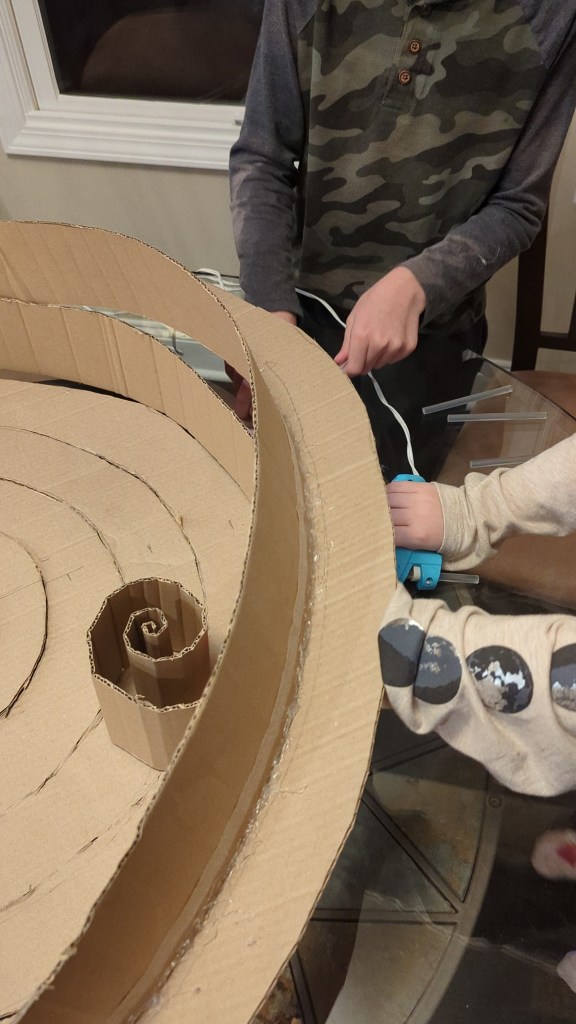
Then the children decided to build a spiral.
Their roller coaster would be scored partly on length and speed, and somewhere along the way, six elementary students decided that one part of their design should be a handmade spiral squeezed onto a two-foot-by-two-foot square.
I knew this was a terrible idea.
I mean, I knew.
I could see all the problems.
It was going to be difficult to construct.
It was going to take forever.
It was going to require an absurd level of precision for a group of elementary students working with the materials they had.
And the biggest problem?
What if it didn’t work?
We had a competition coming.
Time mattered.
If they spent weeks building this thing and discovered at the end that the golf ball couldn’t make it through, we couldn’t get those weeks back.
Every practical adult instinct I had was screaming:
Please abandon the spiral.
But I couldn’t tell them that.
So they kept going.
For nearly two months.
Two months of sketching, measuring, cutting, testing, adjusting, hot-gluing, and rebuilding.
And approximately 400 Band-Aids.
And ice packs.
So many ice packs.
Meanwhile, I sat nearby thinking about the calendar.
And biting my tongue.
There were moments when I desperately wanted to redirect them.
I was allowed to ask questions, and questions can be incredibly powerful.
But even there, I began to realize I had to be careful.
Maybe my guiding question moves them forward.
But maybe it moves them toward my idea of forward.
That distinction has stayed with me.
Because I didn’t just risk solving the problem for them.
I risked squashing the creativity that might lead somewhere I couldn’t see yet.
So the spiral continued.
And here’s the part that still makes me laugh.
It worked.
Not barely.
Not “Well, at least they learned something.”
It worked spectacularly.
The spiral wasn’t their entire roller coaster, but it became its most successful feature.
That two-foot-by-two-foot square contained 37 feet of track.
Thirty-seven.
Feet.
The feature I had spent two months quietly worrying was going to waste their time ended up adding so much length to their roller coaster that their design blew the others out of the water.
That first-year team went to the regional tournament.
They won.
Then they went to the state tournament.
They won again.
And suddenly, the six children whose spiral I would have actively and enthusiastically squashed if anyone had given me permission were headed to Global Finals.
On the strength of THEIR ideas.
Not mine.
Especially not mine.
I wish I could tell you that one experience immediately cured me of the instinct to jump in and help.
It did not.
I’m a work in progress.
But Destination Imagination has spent years providing me with increasingly convincing evidence that children are capable of extraordinary things when adults stop deciding what extraordinary is supposed to look like.
My daughter’s team kept competing.
They kept qualifying for Global Finals.
And year after year, some of the ideas that made their solutions remarkable were precisely the ideas I probably would have questioned, redirected, simplified, or loudly steered away from.
Fast forward to my daughter’s seventh-grade year.
By then, her team was an all-girls team competing in the Technical Challenge.
And apparently, several years of being left to their own devices had not made their ideas any less unusual.
Their solution included something called an Infinite Bacon Pig.
Yes.
An Infinite Bacon Pig.
I’m going to leave that right there.
That all-girls middle school team went to Global Finals and finished third in the world.
Third.
In the world.
At some point, a person has to consider the possibility that maybe the ideas she wouldn’t have approved are doing just fine without her approval.
The spiral hadn’t been a fluke.
Year after year, I watched these kids create solutions I wouldn’t have thought of and, in some cases, probably wouldn’t have encouraged.
Eventually, I had to confront something uncomfortable.
Expertise comes with assumptions.
As adults, we look at problems through everything we’ve already learned.
Experience tells us what’s practical.
What’s efficient.
What’s likely to work.
What’s probably a waste of time.
And that expertise is valuable.
But it can also narrow the field of possibilities before children have had the chance to explore it.
Sometimes children can imagine possibilities precisely because nobody has taught them yet why those possibilities supposedly won’t work.
And then every once in a while…
they build the spiral anyway.
I think about that spiral often when I’m teaching.
Because helping feels like such an obviously good thing.
A child struggles.
We know something that could make the struggle easier.
Why wouldn’t we help?
Sometimes we absolutely should.
Children need instruction. They need feedback. They need encouragement. They need tools, knowledge, examples, and support.
But I’ve started asking myself a much harder question:
When does helping stop being helpful?
Every time I step in, I change what happens next.
Maybe I save a student twenty minutes of frustration.
But maybe I also remove twenty minutes of experimenting.
Maybe I prevent a failure.
But maybe I also prevent the discovery that would have followed it.
And maybe my perfectly crafted guiding question moves the thinking forward.
But I have to ask myself:
Forward toward what?
Toward their idea?
Or mine?
That’s the part Destination Imagination forced me to confront.
I used to think productive struggle meant giving students enough time to work through something difficult without rescuing them too quickly.
I still believe that.
But now I think there’s another kind of productive struggle made especially for teachers. That’s much harder for me to work through.
It’s the kind where I don’t know where they’re going.
It’s one thing to watch a child struggle toward a solution I already know will work. I can stand back feeling relatively confident that they’ll eventually get there.
It’s another thing entirely to watch them invest two months in a spiral I’m fairly certain is going to fail.
That’s when autonomy gets uncomfortable.
When I can’t predict the solution.
When their path looks inefficient, strange, or completely ridiculous to me.
When I’m watching the calendar and wondering whether we’re about to lose two months of work.
When everything I’ve learned through experience is telling me to intervene.
And I choose to leave room for the possibility that I might be wrong.
That’s much harder.
It also creates possibilities I could never design for them.
Destination Imagination taught me something I thought I already understood about student agency.
Giving children autonomy doesn’t mean giving them freedom to arrive at the solution I would have chosen.
It means accepting that they may choose a solution I would never have approved.
And then having enough humility to admit that it might be better.
That’s difficult for adults.
We have experience.
We have expertise.
We can see mistakes coming.
We want to protect children from wasting time, being frustrated, and failing.
But maybe efficiency isn’t always the goal.
Maybe sometimes the two months matter.
Maybe the wrong turns matter.
Maybe the arguments matter.
Maybe even the Band-Aids and ice packs matter.
Because when that roller coaster finally worked, those six children didn’t have to wonder whose idea it was.
It was theirs.
Completely.
I hadn’t saved them.
I hadn’t redirected them.
I hadn’t even believed in the spiral.
They did.
And they were right.
Years later, I still have to resist the urge to help.
But now, when I see a student heading toward a solution I would never choose, I try to remember a two-foot-by-two-foot square containing 37 feet of track, six determined children, and a teacher sitting nearby who was absolutely certain this was not going to end well.
Sometimes the best thing I can contribute to a child’s thinking…
is enough space for it to become something I never imagined.
And if I ever forget that, apparently there’s an Infinite Bacon Pig somewhere in the world ready to remind me.
When does helping stop being helpful?
 Meraki Minds
Leave a comment