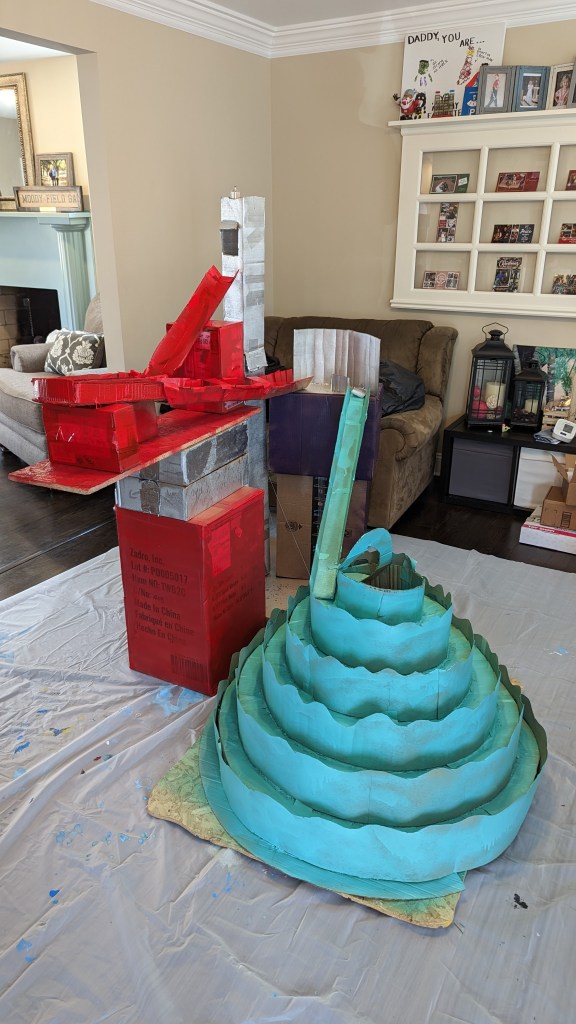
• Look for Blue Button Moments

    A few years ago, my daughter’s Destination Imagination team took on the Scientific Challenge.

    Their solution included time travel, surprise endings, a trip to the planet K2-141b, and, as all good science-fiction stories apparently require, a mysterious button that absolutely should not be pressed.

    In the original version of the story, the button was red.

    Of course it was.

    Red buttons practically exist to communicate:

    DO NOT PRESS THIS BUTTON.

    Which, in fiction, naturally means someone must press it immediately.

    The team performed their solution at the regional tournament, did incredibly well, and won.

    The red button had caused no problems.

    No one suggested it needed fixing.

    Then, after the tournament, I was talking with the mom of one of our newer team members. She had watched several other teams compete that day and was telling me how interesting it was to see all the different ways teams had interpreted the same challenge.

    Then she mentioned something funny.

    Almost every story had a red button.

    Different teams.

    Different plots.

    Different solutions.

    Red button.

    Red button.

    Red button.

    I mentioned it to the team.

    That was all it took.

    Apparently, if everyone else had a red button, we most certainly could not have a red button.

    The button became blue.

    And one line in the script changed.

    When Harleen noticed the mysterious button and asked what it did, Elaina answered:

    “I don’t know, but it’s not red…”

    Pause.

    Eyebrow raise toward the appraisers.

    “…so I’m gonna press it.”

    It was a tiny change.

    The entire story didn’t need to be rewritten.

    The set didn’t need to be redesigned.

    The team didn’t suddenly earn fifty bonus creativity points because they had discovered the color blue.

    But something interesting happened.

    The appraisers noticed.

    At Destination Imagination tournaments, teams receive comments from the appraisers, virtual sticky notes, pointing out things they found funny, clever, impressive, or memorable.

    And tournament after tournament, at least one appraiser mentioned the blue button.

    Not just the button.

    The fact that it wasn’t red.

    I can imagine why.

    After watching performance after performance, the red button probably starts to feel inevitable.

    And then one team walks in with a blue one.

    Better yet, they pause mid-performance, raise an eyebrow, and make sure you know that they know.

    The team went on to win the state tournament and compete at Global Finals.

    Did the blue button make that happen?

    Of course not.

    Was it the difference between a winning solution and a losing one?

    Probably not.

    But was it memorable?

    Absolutely.

    And I think that’s what I love about the story.

    The red button wasn’t bad.

    It worked.

    It made sense.

    The team had already created a successful solution around it.

    They just learned that it was also the obvious choice.

    And instead of saying, Good enough, they looked again.

    That’s a different kind of creativity than coming up with the first big idea.

    Sometimes creativity is invention.

    Sometimes it’s taking something that doesn’t work and finding a way to make it work.

    But sometimes creativity is looking at something that works perfectly well and asking:

    Could this be more interesting?

    Could it be more surprising?

    Could it feel more like us?

    Sometimes the first clue that an idea deserves another look is simply how easily we arrived at it.

    Not because first ideas are bad.

    Not because everything needs to be different for the sake of being different.

    But because the idea that came quickly to us may have come quickly to everyone else too.

    The following year, the team sat down at the beginning of the season to create our team norms.

    They talked about how they wanted to work together, what mattered to them, and what they wanted to remember as they tackled another challenge.

    The last norm they added was:

    Look for blue button moments.

    That’s when I knew the blue button had become something bigger than a funny line in a script.

    They had developed their own shorthand for creative thinking.

    Don’t stop just because it works.

    Look again.

    Where did we choose the expected thing?

    Where might we push the idea a little further?

    What could make this solution more distinctly ours?

    Now I tell this story to my students when we begin brainstorming our first project of the year.

    Eventually, they know the question is coming.

    What’s your blue button moment?

    I’m not asking them to make something weird.

    I’m not asking them to decorate a perfectly good idea until it becomes “creative.”

    I’m asking them to take another look at their thinking.

    To notice where they’ve settled.

    To wonder whether the first possibility has to be the final one.

    Because creativity isn’t always a lightning bolt.

    Sometimes it’s a second look.

    A small change.

    A willingness to ask one more question after you’ve already found an answer that works.

    And every once in a while, it’s simply noticing the red button…

    and deciding to make it blue.
  • Creativity Isn’t a Subject 

    Some of the teachers who eventually became our strongest champions of STEM education began as some of its biggest skeptics.

    Of course they did.

    Don’t we teach students to question everything?

    Apparently, those teachers understood the assignment.

    Okay, I’m not entirely sure that’s what they were thinking at the time. But still.

    Our school was working toward STEM designation in Ohio, and our designation team participated in a series of professional learning experiences that became some of the best schoolwide professional growth I’ve ever experienced.

    Because STEM designation wasn’t something a handful of science and math teachers could accomplish while everyone else cheered them on from down the hall.

    Every teacher had to be part of the shift.

    Math and science, obviously. But also reading. Writing. Social studies. Art. Music.

    No subject was safe.

    And I mean that in the best possible way.

    We weren’t trying to add more STEM activities to the school day. We were trying to create a shift in learning culture.

    One part of that shift was identifying the habits of mind we wanted students to carry across classrooms, across subjects, and eventually into their lives.

    Our school adopted the 5Cs:

    Creativity. Critical Thinking. Collaboration. Communication. Citizenship.

    But as we talked about these habits, we started wondering:

    If we say we value them, when are students actually supposed to learn how to use them?

    Think about collaboration.

    We put four students together during math and ask them to solve a challenging problem. We want them to collaborate, but they’re also trying to understand the mathematics, remember what they learned yesterday, interpret the problem, test strategies, and check calculations.

    And we’re probably paying close attention to the mathematics too.

    As we should.

    So when does collaboration ever get to be the most important thing happening in the room?

    Our professional learning inspired us to wonder what would happen if, every once in a while, we let the habit itself become the lesson.

    Not for an entire unit.

    Not even for an entire class period.

    Just long enough to practice it.

    So I began creating short design sprints teachers could use during morning meetings around events like STEM Day, Hour of Code, and Engineers Week.

    For a few minutes, the academic content stepped aside.

    The habit could simply be the habit.

    Students could try something, struggle, disagree, change their minds, try again—and then talk about what their brains had just done.

    What happened when your first idea didn’t work?

    What happened when someone else’s idea changed yours?

    What did your group do when you disagreed?

    When did you suddenly see a possibility you couldn’t see before?

    We weren’t studying creativity.

    We were experiencing it.

    And that distinction started to feel really important to me.

    We don’t just want students to know what creativity is. We want them to recognize what it feels like when their own mind is being creative.

    That’s metacognition meeting creativity.

    Eventually, I brought a problem to my Discovery students, who had been practicing these habits in class since second grade:

    How might we share what we’ve learned with the rest of our school?

    Their answer was Mindful Monday.

    Each week, students focused on one of the 5Cs during our morning announcements. They explained the habit, led the school through a one- or two-minute activity requiring no supplies, and encouraged everyone to notice that C throughout the week.

    Where did creativity show up?

    When did your group need better communication?

    When did critical thinking help you solve something?

    The students weren’t merely learning the culture.

    They helped build it.

    That’s agency in action.

    It was service too. They had spent years developing habits that could now be useful to someone else.

    And the teachers were practicing right alongside them.

    Mindful Monday continues today because habits of mind don’t become habits simply because we value them.

    Habits become habits because we practice them.

    We understand this almost everywhere else.

    Athletes repeat movements.

    Musicians practice scales.

    Readers practice decoding until they no longer have to think consciously about every familiar word.

    So why would thinking be different?

    Not worksheets about creativity.

    Not vocabulary quizzes on collaboration.

    Experiences.

    Short, deliberate opportunities to practice a way of thinking and notice what your own brain is doing.

    Maybe we’re building a kind of muscle memory for the mind.

    And here’s the interesting contradiction:

    Creativity isn’t a subject.

    Neither is critical thinking. Or collaboration. Or communication. Or citizenship.

    They’re ways of thinking, working, interacting, and participating in the world.

    A mathematician notices a pattern nobody else noticed.

    Creativity.

    A historian looks at familiar evidence and asks a different question.

    Creativity.

    A student turns two whole numbers into a fraction and accidentally teaches his math teacher a new way to find the greatest common factor.

    Definitely creativity.

    Creativity belongs everywhere thinking happens.

    And yet, maybe that’s exactly why it sometimes needs a few minutes of its own.

    Those short design sprints were the practice field.

    On the practice field, we could isolate a habit. Try it. Notice it. Talk about it. Try again.

    Then we left the practice field.

    School is the laboratory.

    Now creativity has to show up in mathematics. Collaboration has to survive disagreement. Communication has to help someone understand an idea. Critical thinking has to appear when the answer isn’t obvious. Citizenship has to shape how we participate in a community.

    And ultimately, even school isn’t the destination.

    Life is.

    Because someday there won’t be a teacher standing beside our students saying, “This looks like a situation where you should use critical thinking.”

    No one will announce that today’s problem requires creativity.

    There won’t be a rubric reminding them to communicate effectively.

    They’ll encounter a problem, an idea, a disagreement, an opportunity, or something none of us can predict.

    And they’ll have to decide what kind of thinking the moment requires.

    That’s why I don’t think the 5Cs are really school skills at all.

    They’re habits for navigating the world.

    The design sprint is the practice field.

    School is the laboratory.

    Life is where they’ll need it.

    We spend enormous amounts of time deciding what children need to know.

    Maybe we should be just as intentional about deciding how we want them to learn to think.

    Because if we’re serious about developing thinkers, then thinking itself deserves instructional time.

    Which leaves me with a question:

    What are we expecting children to know how to do that we’ve never given them the chance to practice?

  • The “Wrong” Way

    I spent nearly two decades teaching middle school math, which means I’ve seen students solve problems in just about every way imaginable.

    Some were elegant. Some were efficient. Some took the scenic route.

    And some made me stare at the paper for a moment and say, “Okay…show me what you did here.”

    Those were often my favorites.

    One student in particular comes to mind.

    Math was hard for him.

    Really hard.

    But he worked. He tried. He was sweet and always appreciative of help. He was the kind of student you found yourself rooting for because you knew how much effort was behind every success.

    One day, we were working on greatest common factor.

    I had taught my students multiple strategies. They could list factors using the rainbow method. They could use factor trees and prime factorization. We had tools.

    Then this student gave me the correct GCF for two numbers.

    Great.

    “How did you get that?”

    “I simplified my fraction.”

    What?

    There was no fraction.

    We were looking at two whole numbers.

    I could have stopped him right there. I could have reminded him that we weren’t simplifying fractions. I could have redirected him to one of the methods we’d practiced.

    Instead, I was curious.

    “Come show me.”

    He walked to the board and wrote one of the whole numbers as a numerator and the other as a denominator.

    Okay.

    Now we apparently had a fraction.

    Then he started simplifying it.

    He divided the numerator and denominator by a common factor. Then another. And as he worked, he kept track of the numbers he had divided by.

    When the fraction could no longer be simplified, he multiplied those divisors together.

    There it was.

    The greatest common factor.

    I remember looking at it and thinking:

    Wait.

    Does that actually work?

    There was only one reasonable thing to do.

    I gave him another problem.

    It worked.

    So I tried another.

    It worked.

    And another.

    It worked.

    Every. Single. Time.

    At this point, my math-teacher brain was fully invested.

    Then he told me it worked with three numbers too.

    Now he really had my attention.

    “Show me.”

    He wrote three numbers in a vertical line and did exactly what he’d done before. He found a common factor that could divide all three numbers, simplified them step by step, kept track of those divisors, and multiplied them together.

    Greatest common factor of three numbers.

    It worked.

    Of course it worked.

    At some point during this interaction, the roles in the classroom had quietly shifted.

    I wasn’t teaching him anymore.

    He was teaching me.

    And his method was beautiful.

    Not just because it worked mathematically.

    It made sense.

    Students already knew how to simplify fractions. His process connected a new concept to something familiar. They didn’t have to generate long lists of factors and worry about missing a factor pair. They didn’t need to build multiple factor trees and then compare prime factors.

    They could use something they already understood to make sense of something new.

    So the next year, when I taught greatest common factor, I taught his method.

    And the year after that.

    And the year after that.

    Most students preferred it.

    A strategy discovered by a student who struggled with mathematics became one of the most useful strategies in my classroom.

    I think about that often.

    Because there’s a subtle danger in teaching something we know well.

    We know the methods. We know the efficient processes. We know what we’re looking for.

    And sometimes that makes it incredibly easy to look at student work and ask:

    Did they do it correctly?

    But that’s not quite the same question as:

    What are they thinking?

    If I had only looked for the process I taught, I would have missed his mathematics completely.

    His work might have looked wrong because there wasn’t supposed to be a fraction.

    But he wasn’t confused.

    He was connecting.

    He had taken something he already understood and used it to make sense of something new.

    Isn’t that exactly what we want mathematicians to do?

    Make connections. Look for structure. Recognize relationships. Use what they know to figure out what they don’t.

    He didn’t reproduce my mathematics.

    He made mathematics his own.

    And I think there’s something important in that.

    Creativity isn’t a subject.

    We sometimes act as though students “do creativity” at certain designated times.

    They create when they’re making art.

    They create when they’re writing stories.

    They create when they’re building something in STEM.

    They create when we hand them an open-ended project and tell them to be innovative.

    But I hadn’t given this student a creative math task.

    I hadn’t said, Find an innovative new method for calculating GCF.

    I taught him mathematics.

    And then his brain connected it differently.

    He took what he’d learned about simplifying fractions, recognized a mathematical relationship, tested it, generalized it to three numbers, and created a process that made sense to him.

    That’s mathematical creativity.

    Maybe creativity isn’t something we need to add to the curriculum.

    Maybe it’s something we need to learn to recognize when it appears.

    Because it can show up anywhere.

    In mathematics.

    In science.

    In history.

    In the way a child organizes information.

    In the question they ask.

    In the connection they make.

    In a process no one taught them.

    Meraki is about putting something of yourself into what you create.

    Apparently, meraki can show up in GCF too.

    I love that.

    Because his process carried something of him. It reflected what he understood, how he made connections, and the way his mind had found a path through the mathematics.

    And if I had been too focused on whether he followed the process I taught, I might have corrected the very thinking I should have been celebrating.

    That’s stayed with me.

    When a student’s work doesn’t look the way I expect, I try not to begin with:

    “That’s not how you do it.”

    I want to begin with:

    “Show me.”

    Because an answer can tell me whether a student landed in the right place.

    Their thinking tells me something much more interesting.

    It tells me how they traveled.

    An answer tells me where you landed. Your thinking tells me how you got there.

    That student showed me a path I hadn’t considered.

    Then I spent years showing his path to other students.

    I can’t help but wonder how many other beautiful ideas are hiding in student work that doesn’t look quite the way we expected.

    What might we discover if we stopped looking for our process and started looking for their thinking?

  • The Day I Stopped Helping

    I am very good at helping.

    I’m a teacher.

    It’s practically an occupational hazard.

    I can spot a problem from across a classroom and immediately start generating solutions.

    Maybe point something out.

    Offer a tool.

    Give them a piece of information they’re missing.

    Surely I can make this easier.

    Right?

    Then my daughter joined Destination Imagination.

    I had no idea what I was getting myself into.

    She started DI in fourth grade. When I signed her up, there was a little box asking whether I would be willing to help.

    Of course I checked it.

    I am a helpful person.

    A few weeks later, I received an email that essentially said:

    “Hi, Team Managers! Here’s your team!”

    Oof.

    Apparently I had volunteered to be in charge.

    And that’s how my co-manager and I, neither of whom had ever done Destination Imagination, ended up with six third, fourth, and fifth graders in my house every week for two hours attempting to build a working roller coaster inside a six-foot-by-six-foot space.

    No one knew what they were doing.

    The children didn’t.

    We didn’t.

    It was perfect.

    If you’ve never experienced Destination Imagination, there’s one rule you need to understand.

    Adults cannot contribute to the team’s solution.

    Not a little.

    Not a suggestion.

    Not a “You know what I would do?”

    Not a strategically raised eyebrow while staring directly at the obviously questionable part of the design.

    Not. A. Single. Solution.

    If an adult contributes to the solution, the team can lose points for interference.

    We could teach skills. We could ask questions. We could help students learn how to use tools safely.

    But the solution has to belong entirely to them.

    I thought I understood this rule.

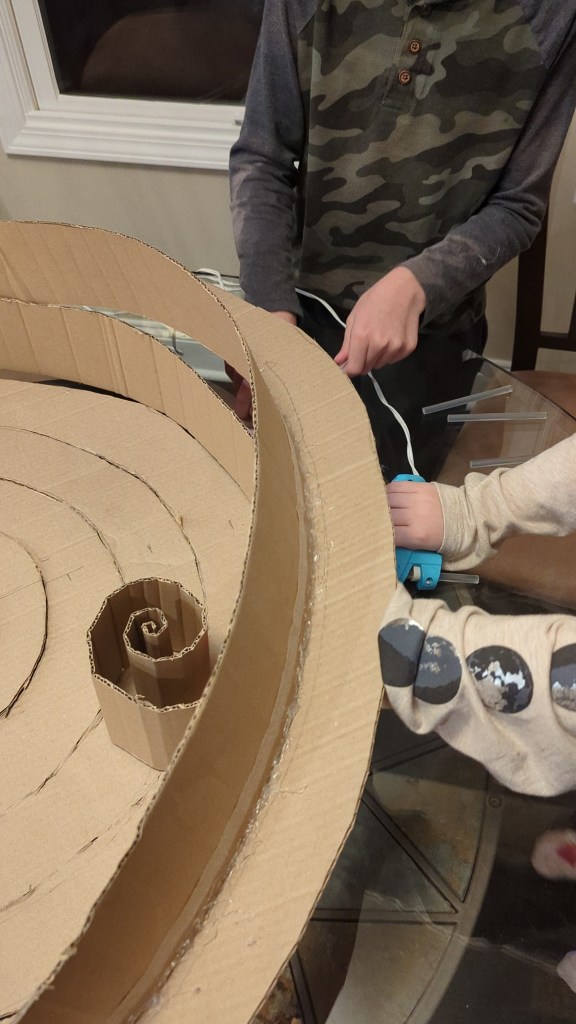
    Then the children decided to build a spiral.

    Their roller coaster would be scored partly on length and speed, and somewhere along the way, six elementary students decided that one part of their design should be a handmade spiral squeezed onto a two-foot-by-two-foot square.

    I knew this was a terrible idea.

    I mean, I knew.

    I could see all the problems.

    It was going to be difficult to construct.

    It was going to take forever.

    It was going to require an absurd level of precision for a group of elementary students working with the materials they had.

    And the biggest problem?

    What if it didn’t work?

    We had a competition coming.

    Time mattered.

    If they spent weeks building this thing and discovered at the end that the golf ball couldn’t make it through, we couldn’t get those weeks back.

    Every practical adult instinct I had was screaming:

    Please abandon the spiral.

    But I couldn’t tell them that.

    So they kept going.

    For nearly two months.

    Two months of sketching, measuring, cutting, testing, adjusting, hot-gluing, and rebuilding.

    And approximately 400 Band-Aids.

    And ice packs.

    So many ice packs.

    Meanwhile, I sat nearby thinking about the calendar.

    And biting my tongue.

    There were moments when I desperately wanted to redirect them.

    I was allowed to ask questions, and questions can be incredibly powerful.

    But even there, I began to realize I had to be careful.

    Maybe my guiding question moves them forward.

    But maybe it moves them toward my idea of forward.

    That distinction has stayed with me.

    Because I didn’t just risk solving the problem for them.

    I risked squashing the creativity that might lead somewhere I couldn’t see yet.

    So the spiral continued.

    And here’s the part that still makes me laugh.

    It worked.

    Not barely.

    Not “Well, at least they learned something.”

    It worked spectacularly.

    The spiral wasn’t their entire roller coaster, but it became its most successful feature.

    That two-foot-by-two-foot square contained 37 feet of track.

    Thirty-seven.

    Feet.

    The feature I had spent two months quietly worrying was going to waste their time ended up adding so much length to their roller coaster that their design blew the others out of the water.

    That first-year team went to the regional tournament.

    They won.

    Then they went to the state tournament.

    They won again.

    And suddenly, the six children whose spiral I would have actively and enthusiastically squashed if anyone had given me permission were headed to Global Finals.

    On the strength of THEIR ideas.

    Not mine.

    Especially not mine.

    I wish I could tell you that one experience immediately cured me of the instinct to jump in and help.

    It did not.

    I’m a work in progress.

    But Destination Imagination has spent years providing me with increasingly convincing evidence that children are capable of extraordinary things when adults stop deciding what extraordinary is supposed to look like.

    My daughter’s team kept competing.

    They kept qualifying for Global Finals.

    And year after year, some of the ideas that made their solutions remarkable were precisely the ideas I probably would have questioned, redirected, simplified, or loudly steered away from.

    Fast forward to my daughter’s seventh-grade year.

    By then, her team was an all-girls team competing in the Technical Challenge.

    And apparently, several years of being left to their own devices had not made their ideas any less unusual.

    Their solution included something called an Infinite Bacon Pig.

    Yes.

    An Infinite Bacon Pig.

    I’m going to leave that right there.

    That all-girls middle school team went to Global Finals and finished third in the world.

    Third.

    In the world.

    At some point, a person has to consider the possibility that maybe the ideas she wouldn’t have approved are doing just fine without her approval.

    The spiral hadn’t been a fluke.

    Year after year, I watched these kids create solutions I wouldn’t have thought of and, in some cases, probably wouldn’t have encouraged.

    Eventually, I had to confront something uncomfortable.

    Expertise comes with assumptions.

    As adults, we look at problems through everything we’ve already learned.

    Experience tells us what’s practical.

    What’s efficient.

    What’s likely to work.

    What’s probably a waste of time.

    And that expertise is valuable.

    But it can also narrow the field of possibilities before children have had the chance to explore it.

    Sometimes children can imagine possibilities precisely because nobody has taught them yet why those possibilities supposedly won’t work.

    And then every once in a while…

    they build the spiral anyway.

    I think about that spiral often when I’m teaching.

    Because helping feels like such an obviously good thing.

    A child struggles.

    We know something that could make the struggle easier.

    Why wouldn’t we help?

    Sometimes we absolutely should.

    Children need instruction. They need feedback. They need encouragement. They need tools, knowledge, examples, and support.

    But I’ve started asking myself a much harder question:

    When does helping stop being helpful?

    Every time I step in, I change what happens next.

    Maybe I save a student twenty minutes of frustration.

    But maybe I also remove twenty minutes of experimenting.

    Maybe I prevent a failure.

    But maybe I also prevent the discovery that would have followed it.

    And maybe my perfectly crafted guiding question moves the thinking forward.

    But I have to ask myself:

    Forward toward what?

    Toward their idea?

    Or mine?

    That’s the part Destination Imagination forced me to confront.

    I used to think productive struggle meant giving students enough time to work through something difficult without rescuing them too quickly.

    I still believe that.

    But now I think there’s another kind of productive struggle made especially for teachers. That’s much harder for me to work through.

    It’s the kind where I don’t know where they’re going.

    It’s one thing to watch a child struggle toward a solution I already know will work. I can stand back feeling relatively confident that they’ll eventually get there.

    It’s another thing entirely to watch them invest two months in a spiral I’m fairly certain is going to fail.

    That’s when autonomy gets uncomfortable.

    When I can’t predict the solution.

    When their path looks inefficient, strange, or completely ridiculous to me.

    When I’m watching the calendar and wondering whether we’re about to lose two months of work.

    When everything I’ve learned through experience is telling me to intervene.

    And I choose to leave room for the possibility that I might be wrong.

    That’s much harder.

    It also creates possibilities I could never design for them.

    Destination Imagination taught me something I thought I already understood about student agency.

    Giving children autonomy doesn’t mean giving them freedom to arrive at the solution I would have chosen.

    It means accepting that they may choose a solution I would never have approved.

    And then having enough humility to admit that it might be better.

    That’s difficult for adults.

    We have experience.

    We have expertise.

    We can see mistakes coming.

    We want to protect children from wasting time, being frustrated, and failing.

    But maybe efficiency isn’t always the goal.

    Maybe sometimes the two months matter.

    Maybe the wrong turns matter.

    Maybe the arguments matter.

    Maybe even the Band-Aids and ice packs matter.

    Because when that roller coaster finally worked, those six children didn’t have to wonder whose idea it was.

    It was theirs.

    Completely.

    I hadn’t saved them.

    I hadn’t redirected them.

    I hadn’t even believed in the spiral.

    They did.

    And they were right.

    Years later, I still have to resist the urge to help.

    But now, when I see a student heading toward a solution I would never choose, I try to remember a two-foot-by-two-foot square containing 37 feet of track, six determined children, and a teacher sitting nearby who was absolutely certain this was not going to end well.

    Sometimes the best thing I can contribute to a child’s thinking…

    is enough space for it to become something I never imagined.

    And if I ever forget that, apparently there’s an Infinite Bacon Pig somewhere in the world ready to remind me.

    When does helping stop being helpful?

  • Cheer for ALL of Them

    High school football games might be one of my favorite things in the world.

    And honestly, the football is only part of it.

    There’s something wonderfully simple about a Friday night under the lights. The players are playing. The cheerleaders are cheering. The band is playing entirely too loudly. The student section is doing whatever the student section does. Parents are embarrassing their children from the stands.

    For a few hours, hundreds of kids get to be completely invested in something they love.

    I love that.

    Maybe because I spend so much of my professional life wondering how we help children find the thing that makes them want to get up at three o’clock on a Saturday morning just so they can get back to doing it.

    At a Friday night football game, I get to watch hundreds of them finding it.

    Last night, though, I noticed something.

    We were sitting behind the family of one of the football players. They were excited. Really excited. They stood and cheered for their child, and I genuinely loved watching that.

    At one point, an older fan asked if they would sit so the people behind them could see the game.

    They made it pretty clear that wasn’t happening.

    They were there to watch their kid.

    Fair enough.

    But it made me start looking around the stadium.

    There were hundreds of people in those stands. A huge portion of them were families of band members.

    And they were cheering too.

    When the football team made a great play, they cheered. When someone scored, they cheered. When the cheerleaders got the crowd going, they joined in.

    They had come because their children were in the band, but for most of the game, they were cheering for someone else’s kids.

    Then halftime came.

    The band took the field.

    And people started leaving.

    Concessions. Bathroom. Time to find someone sitting in another section. Time to talk.

    And I found myself watching people stream out of the stands while a group of KIDS walked onto the field to do the thing they had spent countless hours preparing to do.

    It made me a little sad.

    Because I don’t think most people mean anything by it.

    We’re simply paying attention to the thing we came to see.

    But I found myself wondering:

    Do we realize those are someone’s children too?

    My son is one of those kids.

    So I know what happens long before the band ever takes the field on Friday night.

    These kids practice every day, often for three, four, or five hours. They learn music. They memorize movement. They learn to play while moving, watch one another, listen to one another, respond to cues, and somehow move as one enormous organism while carrying instruments that were definitely not designed with marching in mind.

    Many of them play multiple instruments.

    They spend Friday night in the stands supporting the football team, perform their own show, finish the game, go home, and many times wake up early Saturday morning to travel (sometimes two or three hours) to a marching band competition.

    Then they do it again.

    And again.

    And again.

    I don’t say that because I think band kids work harder than football players.

    This isn’t a competition over whose passion is most deserving of our respect.

    I say it because from the stands, it’s easy to see only the performance and miss all the becoming that happened before it.

    And while we’re at it, can we talk about the cheerleaders for a minute?

    I was one once, so maybe I’m a little biased.

    Those kids may look small.

    But they are mighty!

    They spend hours in the gym learning to tumble. They strength train so they can lift another human being over their heads. They learn timing, balance, coordination, trust, endurance, and the ability to remain remarkably calm while someone is flying through the air above them, or trusting they will be caught.

    They are athletes.

    Full stop.

    And they don’t always get the respect they deserve either.

    Which is when I realized that maybe what I love so much about Friday night isn’t any one of these things.

    It’s all of them.

    No single group owns Friday night.

    The football players provide the game.

    The cheerleaders give us energy.

    The band gives it a soundtrack.

    The students give it personality.

    The families fill the stands.

    Together, they create something none of them could create alone.

    That’s the magic.

    Take away the band, and Friday night feels different.

    Take away the cheerleaders, and it feels different.

    Take away the student section, the families, the coaches, the volunteers, the little kids running around in school colors imagining the day they’ll be out there too…

    It all matters.

    Because community isn’t created by everyone making the same contribution.

    It’s created when people bring different contributions and somehow build something bigger together.

    Maybe that’s why last night stayed with me.

    I spend so much time thinking about how we help children discover what they love.

    We tell them to find their passion. Find their strengths. Work hard. Join something. Contribute. Find their people. Discover the thing that lights them up.

    And then there I was, sitting in a stadium filled with children who were doing exactly that.

    Some had found football.

    Some had found music.

    Some had found cheer.

    Some had found the glorious chaos of the student section.

    Their thing didn’t have to be the same thing.

    That’s the point.

    We don’t need every child to become passionate about the same things.

    We need them to discover that there is something worth becoming passionate about.

    And when they do, maybe one of the simplest things the rest of us can do is notice.

    We see children performing. We don’t always see children becoming.

    We don’t see the thousands of repetitions before the touchdown.

    We don’t see the hours in the gym before the cheerleader flies into the air.

    We don’t see the rehearsals before the first note.

    We see the moment.

    But behind that moment is a young person becoming an athlete, a musician, a performer, a teammate, a leader.

    They’re finding out what they’re capable of.

    They’re learning what it means to commit to something.

    They’re discovering what it feels like to contribute something that matters to other people.

    Maybe one of the ways we teach children that their contribution matters is remarkably simple.

    We notice it.

    One of my colleagues, a guidance counselor, used to have a sticker on her water bottle that said:

    I cheer for both teams.

    It was the perfect sticker for her.

    I always liked it, but sitting in those stands Friday night, I started thinking about it differently.

    Maybe cheering for someone else doesn’t take anything away from the person we came to support.

    I can cheer wildly for my own child and still clap for yours.

    I can want our football team to win and still recognize the work happening on the other sideline.

    I can be there for the band and cheer when the cheerleaders nail a stunt.

    There is enough pride to go around.

    Maybe that’s part of what community asks of us.

    Not to care less about our own people.

    To make our circle of people worth cheering for a little bigger.

    Love your kid ridiculously.

    Cheer for them obnoxiously.

    Be incredibly proud of their thing.

    And then save a little applause for someone else’s kid too.

    I’ll keep cheering when the football team scores.

    I’ll cheer when the cheerleaders take to the sidelines.

    I’ll probably cheer embarrassingly loudly when the band marches out, because my kid is one of them and that’s a parent’s prerogative.

    But I hope I never become so focused on watching my own child shine that I forget to notice someone else’s.

    Because everywhere I looked Friday night, kids were doing exactly what we spend so much of their childhood hoping they’ll eventually do.

    They had found something they loved.

    They were working incredibly hard at it.

    They belonged to something bigger than themselves.

    And they were contributing something that only they could contribute.

    What they do matters.

    Not just to their parents.

    Not just when they’re the reason we came.

    It matters because they matter.

    So when someone else’s child takes the field, maybe we stay in our seats for a few more minutes.

    We watch.

    We clap.

    We let them know we see them.

    Cheer for ALL of them.

  • I Don’t Know. What Do You Think?

    I have a confession to make.

    I say “I don’t know” to my students an alarming number of times for someone whose job title contains the word teacher.

    “Mrs. Sopko, how are we supposed to…?”

    “I don’t know. What do you think?”

    “Should we use cardboard for this?”

    “I don’t know. What do you think?”

    “How long should this be?”

    “I don’t know. What do you think?”

    “Is this going to work?”

    “I don’t know. What do you think?”

    “Is this right?”

    I definitely don’t know.

    What do you think?

    At this point, I’m fairly certain some of my students suspect I have no idea what’s happening in my own classroom.

    They’re not entirely wrong.

    Sometimes I genuinely don’t know.

    And those might be my favorite moments.

    “What will happen if we try this?”

    “I have absolutely no idea. Let’s find out.”

    Those are the moments when I get to pull up my own chair and join the conversation.

    But most of the time when I say, “I don’t know. What do you think?” I actually do have an answer.

    I probably know what I would do.

    But that’s exactly the problem.

    If I tell them what I would do, there’s a pretty good chance that’s what they’ll do too.

    And now we’ve lost the opportunity to find out what they would have done.

    Teachers are incredibly efficient answer-giving machines.

    A child asks a question.

    We answer it.

    Problem solved.

    Except sometimes I wonder if we’ve solved the wrong problem.

    The student’s problem was not knowing.

    But not knowing is precisely where thinking begins.

    I see this most often when students are working on something open-ended.

    “How big should I make it?”

    “What should I use?”

    “How many do I need?”

    “Where should this go?”

    “Is this what you want?”

    That last one is the question I will almost never answer.

    Especially with gifted students.

    Many of them have become exceptionally good at figuring out what adults want. They know how to follow directions. They know how to meet the rubric. They know how to produce something polished, correct, and impressive.

    Then I give them a task with a fuzzy part.

    There isn’t one right process/material/answer.

    The directions don’t explain precisely what the finished product should look like.

    And suddenly…

    “BUT WHAT DO YOU WANT?”

    I don’t know.

    What do you want?

    That discomfort is intentional.

    Not because I enjoy watching children squirm.

    Okay, maybe just a tiny bit.

    But mostly because somewhere along the way, they have to learn to trust their own judgment.

    I tell them this all the time:

    “I’m not always going to be here to help you make this decision.”

    There won’t always be a Mrs. Sopko standing nearby to tell them whether the cardboard is the right material.

    At some point, they’re going to have to look at the problem, consider what they know, make a decision, and live with what happens next.

    And if it doesn’t work?

    Wonderful.

    Now we have something to think about.

    This is one of the reasons I deliberately leave fuzzy spaces in the projects and challenges I design.

    The ambiguity creates room.

    Room to make decisions.

    Room to take risks.

    Room to discover that your first idea wasn’t your best idea.

    Room to realize that someone else’s solution looks nothing like yours.

    Room to change your mind.

    And, eventually, room to trust yourself.

    We talk a lot in education about student agency.

    We want students to take ownership of their learning.

    We want independent thinkers.

    We want creative problem solvers.

    And then we make approximately 4,000 tiny decisions for them every day.

    Use this.

    Put it here.

    Make three.

    Do it this way.

    Start here.

    Stop there.

    Make it look like this.

    And then, after making nearly every meaningful decision for them, we smile and announce:

    “Be creative!”

    I’m not sure that’s how creativity works.

    And I’m pretty sure that’s not agency.

    Agency isn’t something we suddenly hand children when they’re old enough.

    Agency is built through hundreds of small opportunities to decide.

    Which strategy should I try?

    Who should I ask?

    Do I understand this?

    Is there another way?

    What material makes sense?

    What happens if I change this?

    Is this idea worth pursuing?

    Am I satisfied with what I’ve created?

    Those decisions matter.

    And every time I answer one that a student was capable of wrestling with, I wonder if I’ve accidentally taken away a tiny opportunity for them to practice making one.

    That doesn’t mean I don’t teach.

    I do.

    A lot.

    I teach strategies. I teach scholarly habits. I teach students how to think about their own thinking. I teach design thinking. I model processes. I ask questions. I give feedback. I provide information they don’t have and help them build the knowledge they need.

    The goal isn’t to withhold help.

    It’s knowing the difference between an answer that supports thinking and one that replaces it.

    Because sometimes the fastest way to stop thinking is to give someone the answer.

    And I don’t want to steal thinking that belongs to the learner.

    That’s especially true when we’re creating.

    Meraki is the idea of putting something of yourself into what you create: your creativity, your thinking, your experiences, your heart.

    But if I make all the decisions, how much of you can possibly be left in the work?

    A student can follow every direction I give, meet every requirement, and produce something perfectly lovely…

    that contains almost none of them.

    That’s not what I want.

    I want to see the idea I never would have thought of.

    The strange solution.

    The unexpected connection.

    The moment a student looks at something they’ve created and knows, I did that.

    And I’ve learned something after years of trying very hard not to answer questions.

    Students regularly come up with ideas that are better than mine.

    Much better.

    Ideas I couldn’t have anticipated.

    Solutions I wouldn’t have suggested.

    Directions I didn’t know the project could take.

    That can’t happen if I’ve already decided where we’re going.

    Maybe that’s why I keep imagining that ancient classroom beneath the trees.

    Not because there was a teacher sitting at the front with all the answers.

    Because there were people gathered together, wondering, questioning, challenging ideas, and seeing where the thinking might lead.

    Sometimes I know what I would do.

    Sometimes I have a pretty good idea.

    Sometimes I genuinely have no clue.

    But when a student asks me a question they’re capable of wrestling with, my answer is often the same.

    “I don’t know. What do you think?”

    Because those seven words mean much more than they seem to.

    They mean:

    I trust you to have an idea.

    I trust you to try.

    I trust you to be wrong.

    I trust you to change your mind.

    I trust that your answer doesn’t have to look like mine.

    And I trust that your idea might be better than mine.

    Actually, I’m counting on it.

    So maybe the next time a student asks a question you know you don’t need to answer, resist the urge to be the incredibly efficient answer-giving machine teacher are so good at being.

    Try seven words instead.

    I don’t know. What do you think?

    Because now we know everything those seven words actually mean.

    What thinking might happen if you didn’t answer the next question?

  • What’s That?

    For a while, my husband and I were worried that our son wasn’t talking.

    He was almost two years old, and his vocabulary was remarkably efficient.

    He could say “snake.”

    And he could say “What’s that?”

    That was pretty much it.

    Fortunately, “What’s that?” turns out to be an incredibly versatile phrase.

    We’d go for a walk.

    “What’s that?”

    I’d be making dinner.

    “What’s that?”

    He’d sit on my lap and point to something on my shirt.

    “What’s that?”

    Sometimes he’d ask so quickly that we didn’t even have time to answer before his finger had moved on to something else.

    “What’s that? What’s that? What’s that?”

    All day long.

    The strange part was that he seemed to understand quite a lot. We could talk to him. We could ask him to do things. He clearly understood what was happening around him.

    He just wasn’t saying much back.

    Even more confusing, he would sometimes point to something we were absolutely certain he already knew and ask:

    “What’s that?”

    So there we were with a two-year-old who seemed to know exactly two useful things:

    Snakes exist, and the rest of the world requires further investigation.

    As funny as it is to me now, at the time I was worried.

    Was he learning all of these words? Did he know more than he could tell us? Why wasn’t he talking?

    Then one Christmas, we were at my cousin’s house.

    My son was sitting on my lap doing what he always did, pointing at the letters on my shirt and asking his favorite question.

    “What’s that?”

    My aunt was watching him.

    She is a retired teacher, and she knew I was concerned about his language. After observing him for a while, she suggested something simple.

    Turn it back on him.

    Instead of answering his questions, she suggested I start asking some of my own.

    So I did.

    “Where’s the A?”

    He pointed to it.

    Okay.

    “Where’s the M?”

    There it was.

    So I tried another.

    And another.

    And another.

    Wouldn’t you know it?

    He knew the letters.

    All of them.

    I was stunned.

    My child who wasn’t talking had apparently been quietly collecting information the entire time.

    Nothing about him had changed in those few minutes.

    My perspective had.

    I had been so focused on what he wasn’t showing me that I almost missed everything he was.

    Sometimes changing what we see begins with changing how we look.

    And sometimes, learning doesn’t announce itself.

    I think about that Christmas often as a teacher.

    We like visible evidence of learning.

    I certainly do.

    Tell me the answer.

    Show me your work.

    Explain your reasoning.

    Create something.

    Demonstrate what you know.

    And those things matter. We need ways to understand what children know and what they still need.

    But that little boy sitting on my lap reminds me that there can be an enormous amount happening inside a mind before we’re able to see it.

    He had been noticing, sorting, connecting, and remembering.

    And apparently learning letters while he was at it.

    I had been waiting for the learning to come out in the form I expected.

    Words.

    Instead, my aunt gave me another way to look.

    That’s stayed with me.

    How often do we mistake not showing us for not knowing?

    How often do we assume nothing is happening because we can’t see the evidence we’re looking for?

    And how often might a child be telling us something about their thinking in a form we haven’t learned to recognize yet?

    My son’s “What’s that?” fascinates me even more when I think about it now because I’m not convinced he was always asking for an answer.

    Sometimes he already knew the answer.

    Sometimes he didn’t even wait long enough to hear one.

    Maybe he was collecting words.

    Maybe he was confirming what he knew.

    Maybe he was experimenting with language.

    Maybe he had simply discovered a remarkably effective way to keep every adult around him engaged in a nonstop conversation.

    I don’t know.

    And I love that I don’t know.

    What I do know is that he was paying attention.

    There was an entire world around him, and he was taking it in as quickly as he could point.

    Then, eventually, something remarkable happened.

    He started talking.

    Not gradually in the way I had expected.

    It was more like someone flipped a switch.

    Suddenly, there were sentences.

    Full sentences.

    All of those words we’d wondered whether he was collecting seemed to have been in there after all.

    He had been learning long before he was ready to show us.

    I’ve spent a lot of my career thinking about how to create curious learners.

    The older I get, the more I wonder if that’s the wrong goal.

    Children arrive curious.

    They point.

    They touch.

    They take things apart.

    They collect things adults would absolutely classify as garbage.

    They ask questions we know the answers to.

    They ask questions we don’t know the answers to.

    They ask questions they apparently already know the answers to.

    And sometimes they ask the next question before we’ve even finished answering the first one.

    Maybe our job isn’t to create curiosity.

    Maybe it’s to recognize it.

    To make room for it.

    To take it seriously.

    And to resist assuming that because we can’t see learning yet, it isn’t happening.

    Because “What’s that?” eventually becomes “Why?”

    Then “What if?”

    Then “How do we know?”

    And perhaps one day:

    “What would happen if…?”

    That’s the life of the mind beginning to unfold.

    It doesn’t begin with knowing.

    It begins with paying attention.

    My son is long past the “What’s that?” phase now, but I still think about that little boy sitting on my lap at Christmas.

    And I think about my aunt, who looked at the same child I was looking at and saw something I couldn’t see yet.

    She didn’t change him.

    She changed the question.

    And that changed what I was able to see.

    I try to remember that when I look at my students, too.

    Because sometimes changing what we see begins with changing how we look.

    What might we discover about a child if we change the question we ask?

  • School Is the Laboratory

    Grace wasn’t struggling in my math class.

    That was the problem.

    She was a student in one of my co-taught classes, where many of the students needed extra time and support to learn new mathematical concepts.

    Grace didn’t.

    She picked things up quickly. She was curious, capable, and usually ready to move on while the rest of the class wasn’t.

    And I didn’t want to make her wait.

    At first, this seemed like a differentiation problem. How could I give Grace something more challenging while continuing to give other students the time they needed?

    But the longer I thought about it, the more uncomfortable the question became.

    Why should Grace have to wait?

    And just as importantly, why should another child have to hurry?

    Neither student was doing anything wrong.

    The problem wasn’t their pace.

    The problem was the system I had built around it.

    From the early days of my teaching career, I had been questioning what mathematics instruction should look like. I believed deeply in constructivist practices. I wanted students solving problems, making connections, discussing ideas, and actually doing mathematics.

    I wanted them discovering mathematics.

    I wanted them exploring patterns, building processes, testing their thinking, and eventually using those discoveries to make sense of the algorithms we so often simply hand to children.

    I wanted them to understand where the mathematics came from, not just remember what to do with it.

    And still, even in this hands-on, constructivist, best-practice environment, there was an assumption hiding underneath everything.

    We were all moving together.

    Introduce the lesson.

    Explore the concept.

    Practice.

    Apply.

    Move on.

    And somehow, twenty-something children were all supposed to be ready for the next mathematical idea at approximately the same moment.

    What are the odds that every child in a classroom is going to understand dividing fractions at precisely 10:37 on a Tuesday morning?

    And yet, even in the kind of classroom I had worked so hard to create, the traditional structure still asked me to operate as though they would.

    Grace made that impossible for me to ignore.

    So I started experimenting.

    What if students didn’t have to move through mathematics together?

    What if I could keep the expectations high while making the timeline flexible?

    What if students had more responsibility for deciding when they needed practice, when they needed help, and when they were ready to move forward?

    Those questions eventually became what I called the Quadrant System.

    The basic idea was simple. Students moved through learning, practice, application, and extension at a pace that made sense for them. There were expectations and deadlines, but there wasn’t an assumption that everyone needed the same thing at the same time.

    Students who were ready could keep going.

    Students who needed more time could take it.

    Grace needed permission to keep going.

    Other students needed permission to take their time.

    It turned out I could give them both.

    And then something happened that I hadn’t expected.

    The system I had created because I was worried about one student began changing the way everyone in the room learned.

    At first, I noticed the obvious things.

    Students started making more decisions.

    They chose when they needed additional practice. They learned to recognize when they were ready to move forward. They checked their own work, sought feedback, collaborated with classmates, and asked for help when they needed it.

    But eventually I realized something much bigger was happening.

    They were developing agency.

    Instead of waiting for me to tell them what to do next, they were beginning to take ownership of their own learning.

    They were also developing metacognition.

    Do I actually understand this?

    What am I confused about?

    Do I need another example?

    Am I ready for something harder?

    What strategy worked for me this time?

    Those weren’t questions on a worksheet.

    They were questions students were beginning to ask themselves.

    Mistakes changed too.

    When the goal was no longer to keep pace with everyone else, a mistake didn’t necessarily mean I’m bad at math.

    It meant I’m not there yet.

    Students could correct their thinking, try again, ask someone else how they approached the problem, or come sit with me.

    The mathematical practices I had always valued became more authentic. Students persevered. They reasoned. They defended their thinking. They critiqued one another’s reasoning. They chose tools and strategies. They looked for patterns.

    They weren’t practicing those habits because a standard told me to teach them.

    They needed them because they were navigating their own learning.

    And something else happened that mattered enormously to me.

    They learned to advocate for themselves.

    We had open discussions about what mastery looked like. Soon… 

    A student could recognize, I need to work with Mrs. Sopko today.

    Another could decide, I understand this. I’m ready to keep going.

    Someone else could realize, I need to move away from my friends because I’m not getting anything done over here.

    Those might sound like small decisions.

    I don’t think they are.

    They’re the beginnings of knowing yourself as a learner.

    The students who had struggled with mathematics began experiencing something I don’t think some of them had felt very often in a math classroom.

    Confidence.

    They weren’t “behind.”

    They were learning.

    And the students who moved quickly weren’t “finished.”

    They were learning too.

    The goal was never to see who could get through mathematics first.

    The goal was to keep learning.

    That eventually became one of those sentences my students heard from me over and over again:

    “I don’t care when you learn this. I care that you learn this.”

    I meant it.

    The expectation didn’t disappear because a student needed more time.

    And the learning didn’t have to stop because a student needed less.

    For the first time, I began to see what could happen when time stopped being the thing that determined who was “good at math.”

    Students who had entered my classroom convinced they weren’t math people began taking risks.

    They corrected mistakes instead of hiding them.

    They talked about mathematics.

    They helped one another.

    They challenged themselves.

    They trusted themselves.

    Slowly, something shifted.

    They weren’t simply completing math anymore.

    They were becoming mathematicians.

    And I was changing too.

    I had created the Quadrant System because Grace needed something different.

    But the system forced me to give up some of the control I hadn’t even realized I was holding.

    Instead of standing at the front of the room determining exactly what everyone would do next, I spent more of my time sitting beside students, talking about their thinking.

    I got to know how they learned.

    I saw where they struggled.

    I discovered what challenged them.

    I learned when to step in and, perhaps more importantly, when to get out of the way.

    The classroom became more responsive because I became more responsive.

    Looking back, I think that’s when I began to understand something I wouldn’t have had words for at the time.

    School is the laboratory.

    Not because children are experiments.

    Because learning is.

    We observe.

    We wonder.

    We try something.

    We pay attention to what happens.

    We change our minds.

    We revise.

    And then we try again.

    I expect my students to do this constantly. I ask them to take risks, learn from mistakes, question assumptions, change strategies, and remain open to the possibility that their first idea might not be their best one.

    I should be willing to do the same.

    Around that same period in my career, I encountered a question from George Couros’s The Innovator’s Mindset that stayed with me:

    Would you want to be a learner in your own classroom?

    It’s a powerful question.

    But Grace makes me wonder if I need to push it further.

    Because, truthfully, it’s pretty easy for me to imagine wanting to be a learner in a classroom designed by me.

    Of course I would.

    I designed it.

    It reflects the way I think, the things I value, and probably more of my own preferences than I’d like to admit.

    The harder question is:

    Would every child want to be a learner in my classroom?

    The child who needs more time?

    The child who is ready to fly?

    The child who loves mathematics?

    The child who walked through my door already convinced they’re terrible at it?

    The child who wants to work with friends?

    The child who needs quiet?

    Grace?

    Maybe empathy isn’t imagining myself sitting in one of those desks.

    Maybe it’s trying to imagine myself sitting in every one of them.

    I think that’s one of the most important things Grace taught me.

    She never asked me to redesign my classroom.

    She didn’t complain about the system.

    She simply kept being ready before I was ready for her.

    Eventually, I had to change.

    I thought I was creating a way for Grace to keep learning.

    I didn’t know I was creating a classroom that would help other students become more confident mathematicians.

    And I certainly didn’t know that one child sitting in my math class would change the way I thought about teaching for years to come.

    I’m so glad she did.

    Who in your classroom is quietly asking you to change?

  • 3am on a Saturday

    For years, I’ve asked my students the same question.

    “What is the kind of work that would make you want to get out of bed at three o’clock on a Saturday morning just so you could do it?”

    They usually laugh.

    Some think I’m exaggerating.

    Others immediately start throwing out wild ideas.

    But behind the laughter is a question I’ve come to believe is one of the most important questions we can ask.

    Not, What do you want to be when you grow up?

    But, What kind of life are you hoping to build?

    I ask that question because I worry about children, especially gifted children.

    They’re often good at so many things that the world is quick to tell them who they should become.

    Doctors.

    Lawyers.

    Engineers.

    Successful by every outward measure.

    But I hope they pause long enough to ask a different question.

    What kind of work feels like me?

    For me, teaching has always been the answer.

    Not because every day is easy.

    Teaching is wonderfully exhausting. It stretches me, challenges me, humbles me, makes me laugh, and reminds me almost daily how much I still have to learn.

    But even on the hardest days, I’ve never questioned whether this is where I’m meant to be.

    Teaching has always been my ikigai.

    Every year I have the privilege of advising our middle school’s Future City team. We meet after school once a week and several Saturdays throughout the fall, researching, designing, building, and preparing for competition.

    One of my favorite parts isn’t the engineering.

    It’s that many of the students are former Discovery students.

    Officially, they come back to build a city.

    Unofficially…

    They come back to hang out.

    And if I’m being honest, so do I.

    One Saturday morning we were in my classroom surrounded by cardboard, paint, engineering notebooks, and half-finished ideas. Students were scattered around the room solving problems, debating designs, and trying to make impossible ideas work.

    It was exactly where I wanted to be.

    Out of nowhere, one of my sixth graders stopped what he was doing, looked at me, and said,

    “Hey, Mrs. Sopko…I know what your ikigai is.”

    I smiled.

    “Oh yeah?” I asked. “What is it?”

    He looked around the room as though the answer was completely obvious.

    “Well…you’re here on a Saturday morning.”

    He shrugged.

    “So it must be this.”

    I laughed.

    Then I told him he was right.

    Teaching is my ikigai.

    And I hoped he would someday discover his.

    I’ve thought about that conversation many times since.

    Not because I learned something new about myself.

    I’ve known for a long time that teaching is exactly where I’m supposed to be.

    What stayed with me was something much more meaningful.

    A child noticed.

    He wasn’t listening to a lesson about ikigai.

    He wasn’t completing an assignment about purpose.

    He simply watched an adult spend a Saturday morning doing something she genuinely loved.

    That’s when something clicked for me.

    Children don’t just learn from what we teach.

    They learn from what we love.

    That realization has changed the way I think about teaching.

    If I hope my students will someday build lives they can’t wait to wake up to, then they deserve to see adults who genuinely love what they do.

    Not because every day is perfect.

    Not because we’ve figured life out.

    But because purpose is visible.

    Joy is contagious.

    When children see an adult completely absorbed in meaningful work, they begin to understand that work can be more than a paycheck or a title.

    It can become an expression of who you are.

    Maybe that’s why I keep asking the same question, year after year.

    “What is the kind of work that would make you want to get out of bed at three o’clock on a Saturday morning just so you could do it?”

    I don’t expect third graders to know the answer.

    Or sixth graders.

    Truthfully, many adults are still searching.

    But I hope they never stop asking.

    Because I have a feeling that a meaningful life isn’t built by becoming what everyone else expects.

    It’s built by discovering the work that feels unmistakably like your own.

    And perhaps one day, one of my students will find themselves somewhere on a Saturday morning, completely absorbed in work they love.

    I hope someone notices.

    More importantly…

    I hope they notice it themselves.

    When have your students seen you light up because of your work?

  • The Life of the Mind

    Last year, one of my students accidentally gave me one of the greatest compliment I’ve ever received as a teacher.

    It started with a joke.

    One student made a disparaging comment about teachers in general, and I responded with the most dramatic, over the top gasp I could manage.

    “Excuse me,” I said.

    The class burst into laughter because they knew I wasn’t actually offended.

    Then the student looked at me and said something that stopped the room.

    “I’m not talking about you, Mrs. Sopko. I’m talking about real teachers.”

    This time, the entire class gasped.

    I laughed and asked, “Well…what do you think I am?”

    Without even pausing to think, she blurted out,

    “You’re not like real teachers. You don’t teach us stuff. You teach us how to think.”

    I smiled.

    But inside, I was completely overwhelmed.

    It remains one of the greatest compliment I have ever received as a teacher.

    Not because it suggested I was somehow different from other teachers. I know too many extraordinary educators to believe that.

    It was because, in one completely unfiltered sentence, a child put words to something I had been hoping my students would carry with them long after they left my classroom.

    Suddenly, all of those noisy discussions, unfinished ideas, debates around the table, moments of productive struggle, and beautiful classroom chaos felt worth it.

    Maybe they understood.

    Maybe they were beginning to see that learning wasn’t something I delivered to them.

    It was something we were building together.

    I’ve thought about that conversation many times since.

    One thing I’ve realized is that some of the most important ideas in my classroom don’t come from me.

    They emerge from the conversation.

    The funny thing is, I don’t actually think my student was entirely right.

    I do try to teach children how to think.

    We talk openly about metacognition. We practice scholarly habits. We use design thinking when we get stuck. We reflect on our thinking as often as we reflect on our work. We talk about finding our ikigai, the work that gives our lives meaning, and why the best work always carries a little of who we are.

    Those things matter deeply to me.

    But the older I become, the more I realize those aren’t really the destination.

    They’re the tools.

    The real question I’ve been asking myself is much bigger.

    How do we help children build a life they can’t wait to wake up to?

    I ask my students to imagine a future where they wake up at three o’clock on a Saturday morning because they’re so excited to get back to the work they’re doing.

    Not because someone expects them to.

    Not because it pays well.

    Not because it’s impressive.

    Because they simply can’t wait.

    Especially with gifted students, this question feels important. Children who are capable of doing almost anything often grow into adults who become what everyone else expects them to become. Doctors. Lawyers. Engineers. Successful by every outward measure, but never stopping long enough to ask a much more important question.

    What kind of work feels like me?

    I don’t want that for my students.

    I want them to become the authors of their own lives.

    School is the laboratory where they begin that work.

    It’s where they experiment with ideas, creativity, courage, failure, collaboration, and identity. They aren’t simply learning mathematics, science, history, or art.

    They’re discovering who they are.

    Maybe that’s what I mean when I talk about the life of the mind.

    To me, it has very little to do with intelligence.

    It’s about living with curiosity.

    Paying attention.

    Asking thoughtful questions.

    Finding joy in understanding something just a little more deeply than you did yesterday.

    It’s about believing your ideas are worth having.

    Your questions are worth asking.

    Your voice belongs in the conversation.

    Your work should carry a little of who you are.

    Maybe that’s what meraki has been pointing me toward all along.

    Not simply putting yourself into your work.

    But becoming someone whose work naturally reflects who you are.

    When that happens, contribution stops being something you chase.

    It becomes something you can’t help but make.

    If I have a hope for the students who leave my classroom, it isn’t that they’ll remember every lesson I taught.

    It’s that they’ll leave believing they belong in humanity’s ongoing conversation and that they have something meaningful to contribute.

    Not the contribution someone else expects of them.

    The one only they can make.

    Perhaps that’s what my student really meant.

    Not that I teach children how to think.

    But that together, we’ve created a classroom where thinking feels worth sharing.

    If that’s true, then maybe we’re doing something much bigger than learning school subjects.

    Maybe we’re helping young people discover that they already have a place in humanity’s ongoing conversation.

    Perhaps that’s where a meaningful life begins.

    As I continue this journal, I don’t expect to arrive at all the answers. These are simply the conversations I’m still having, and I’d love for you to pull up a chair and join me.

    What kind of life are we helping children build?

  • The Conversation Continues

    In my first journal entry, I wrote that I sometimes imagine what it must have felt like to sit beneath the trees of ancient Greece, surrounded by people wrestling with questions no one had answered before.

    The more I’ve thought about that image, the more I’ve realized it isn’t really ancient Greece that draws me in.

    It’s the conversation.

    Ancient Greece wasn’t remarkable because brilliant people gathered together. It was remarkable because people believed ideas were worth discussing. They asked questions, challenged one another, built on each other’s thinking, and changed their minds when a better argument emerged. Knowledge wasn’t handed down from a mountaintop. It was built together.

    I think that’s why the image continues to stay with me.

    Not because I want to recreate ancient Greece in my classroom.

    Because I want to create a place where every child feels their ideas are worth sharing.

    The longer I teach, the more I find myself wondering if we sometimes present school as though every important question has already been answered. We organize subjects into neat chapters and standards, and without meaning to, we can leave students with the impression that learning is about remembering what other people have already discovered.

    But that isn’t how any discipline began.

    Mathematics began because someone noticed a pattern.

    Science began because someone wondered why.

    History is still being written.

    Art is still evolving.

    Philosophy is still asking questions.

    Every discipline we teach began with curiosity.

    That changes the way I think about school. Maybe our job isn’t simply to help students remember humanity’s greatest ideas. Maybe it’s to invite them into humanity’s greatest conversation.

    Participation.

    That word has been quietly growing in my mind.

    When students believe they are participants instead of spectators, something changes. They stop asking, “Is this the right answer?” and begin asking, “What do you think?” or “What if…?” The conversation becomes more important than the assignment. Learning stops feeling like something happening to them and begins feeling like something they are helping create.

    Those are the moments I remember long after the lesson is over.

    Lately, I’ve noticed something else about myself.

    Every time I become convinced I’ve finally figured something out, my curiosity begins to fade. The conversation becomes quieter. The questions become fewer.

    I’ve started to question if certainty is sometimes the enemy of wonder.

    I’m not sure I’m searching for the right answers anymore.

    I think I’m searching for better questions.

    For me, a really good answer doesn’t end the journey.

    It opens the next one.

    I’m beginning to wonder if a life well lived isn’t defined by finding all the answers.

    Maybe it’s defined by never running out of meaningful questions to ask.

    Perhaps that’s why I wanted this to be a journal instead of a blog.

    I’m not writing because I’ve arrived at a philosophy.

    I’m writing because after over 20 years of teaching, I’m still discovering it.

    These aren’t the conclusions I’ve reached.

    They’re the conversations I’m still having.

    My hope is that every child leaves school believing they belong in humanity’s ongoing conversation and that they have something meaningful to contribute.

    I hope that’s true for teachers, too.

    Because I don’t think we’re simply teaching subjects.

    I think we’re inviting young people into one of humanity’s oldest traditions: wondering together.

    If you’ve chosen to read these journal entries, I’d love to invite you into that conversation with me. I don’t expect us to arrive at all the same conclusions. In fact, I hope we don’t. I hope we ask better questions, challenge one another’s thinking, and leave each conversation with a little more curiosity than we had when we began.

    After all, maybe the goal isn’t to arrive.

    Maybe the goal is to keep walking.

    A question to leave with:

    What question has stayed with you lately?

  • Joining a Conversation That Began Thousands of Years Ago

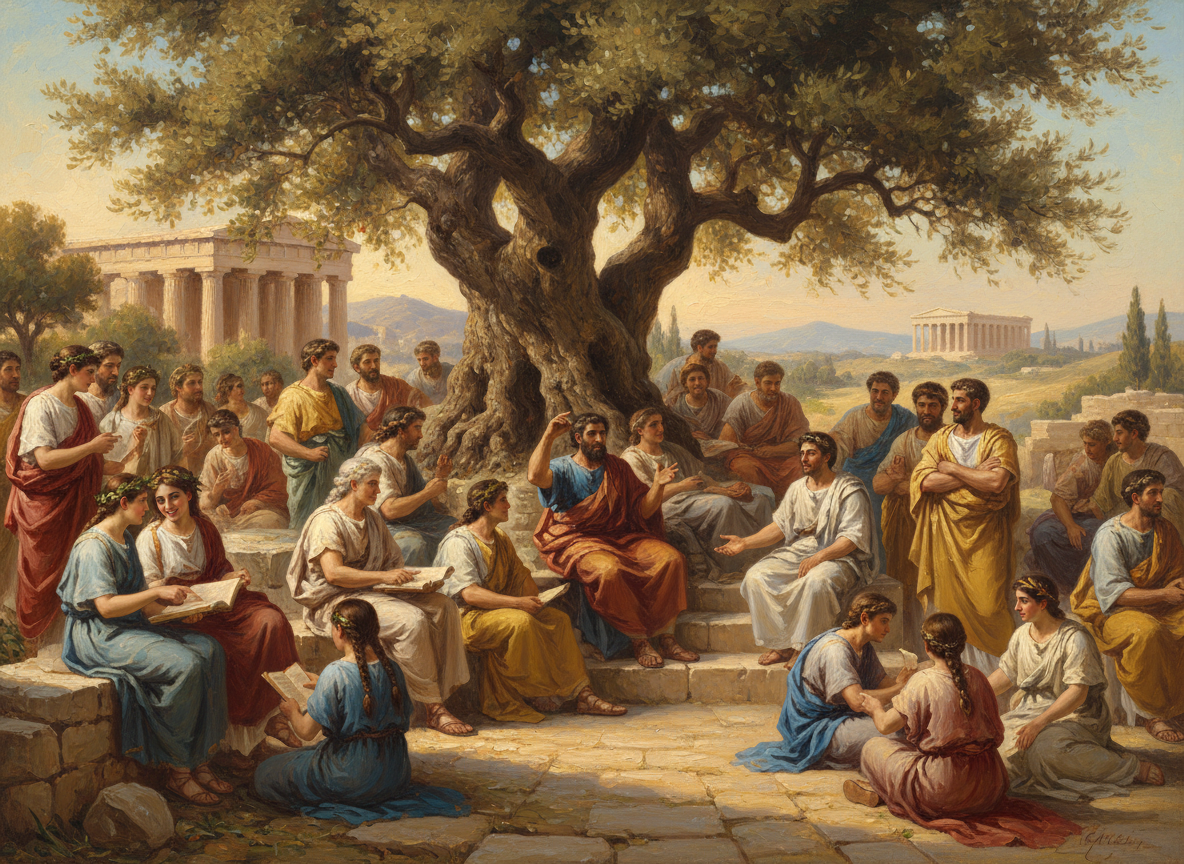
    Ancient Greeks learning together under olive tree

    Sometimes I look around my classroom and imagine what it must have felt like to sit beneath the trees of ancient Greece, surrounded by people wrestling with questions no one had answered before.

    If I had lived in ancient Greece, I like to imagine I would have been sitting among them, asking questions, listening carefully, building on someone else’s ideas, and changing my mind when a better argument emerged.

    They weren’t completing assignments.

    They weren’t trying to earn points.

    They were observing, questioning, debating, and constructing knowledge together.

    Every time I gather with my students around a table, listening as they wonder aloud, challenge one another’s thinking, defend an idea with evidence, or discover a connection none of us had noticed before, I catch a glimpse of that same spirit.

    That is the classroom I’ve spent my career trying to build.


    Welcome to Meraki Minds!

    If you’re here expecting a journal filled with classroom tips, printable resources, and teaching strategies, you’ll certainly find those along the way. But I hope you’ll also discover something deeper.

    Because I don’t believe the most important work we do as educators is simply helping students learn more.

    I believe it’s helping them become more.

    My journey began in a middle school mathematics classroom, where I spent nearly two decades teaching students far more than equations and procedures. From the very beginning, I believed students deserved ownership of their learning. Long before student agency became a familiar phrase in education, I was creating a classroom where students made decisions, assessed their own readiness, collaborated with one another, sought feedback, and challenged themselves to go further.

    My classroom revolved around a simple four quadrant system. Students learned new concepts together, practiced until they felt confident, demonstrated their understanding through meaningful performance tasks, and explored extensions whenever they were ready to think more deeply.

    The system wasn’t really about organization.

    It wasn’t about classroom management.

    It wasn’t even about mathematics.

    It was about trust.

    Trusting students to know when they needed more practice.

    Trusting them to ask for help.

    Trusting them to challenge themselves.

    Trusting them to learn from mistakes.

    Most importantly, trusting them to take ownership of becoming mathematicians instead of simply completing math assignments.

    Looking back, I realize I wasn’t just teaching mathematics. I was helping students develop an identity.

    When I became a full-time Gifted Intervention Specialist, people often assumed I had entered an entirely new chapter of my career.

    In reality, my philosophy hadn’t changed.

    It had simply grown.

    Instead of asking, How do I help students become mathematicians? I found myself asking bigger questions.

    How do students begin thinking like scientists?

    How do they learn to see the world through the eyes of an artist?

    What does it mean to reason like a historian, design like an engineer, or wonder like a philosopher?

    Eventually, all of those questions gave way to one that has become the foundation of everything I create.

    Who will students become because of this experience?

    That question now guides every lesson, every project, every classroom conversation, and every resource I design.

    You’ll notice that many of the ideas shared here return to the same themes:

    Curiosity. Wonder. Meaningful work. Visible thinking. Creative risk taking. Reflection.

    Not because they’re educational buzzwords, but because I believe these are the habits that shape people long after they’ve forgotten the details of a lesson.

    Students may not remember every book they read or every activity they completed.

    But they often remember how learning made them feel.

    How it challenged them.

    How it invited them to think.

    How it helped them discover something about themselves.

    That is the kind of learning that stays with us.

    Eventually, I discovered the Greek word meraki. It describes doing something with soul, creativity, and a little piece of yourself. The moment I encountered that word, it felt as though someone had given a name to what I’d been trying to cultivate all along.

    Not perfect work.

    Meaningful work.

    Work that carries a little of who we are.

    That’s what I hope for my students.

    And it’s what I hope Meraki Minds will encourage in classrooms everywhere.

    Perhaps that’s why I don’t think this journal is really about education.

    I think it’s about the life of the mind.

    Education simply happens to be the place where I have the privilege of inviting children, and the educators who guide them, to experience it.

    If you choose to follow along, you’ll find practical ideas, classroom resources, stories from my own teaching, and reflections on curiosity, creativity, and inquiry.

    But more than anything, I hope you’ll find a community of educators who believe that learning is something we build together.

    I don’t believe classrooms should be places where knowledge is delivered.

    I believe they should be places where ideas are explored together.

    Where teachers remain curious.

    Where students learn to question.

    Where every person in the room leaves knowing a little more than they did when they walked in.

    If I could choose any place in history to sit and learn, it might just be beneath those trees.

    Since I can’t, I’ve spent my career trying to build the next best thing.

    Welcome to the conversation.

    I’m so glad you’re here.